According to Burlington records, 1,516 men and 17 women from the Queen City served in the first world war. And “for the most part, where they served, what actions they saw, and what they experienced are lost to time,” wrote local historian Vincent Feeney.
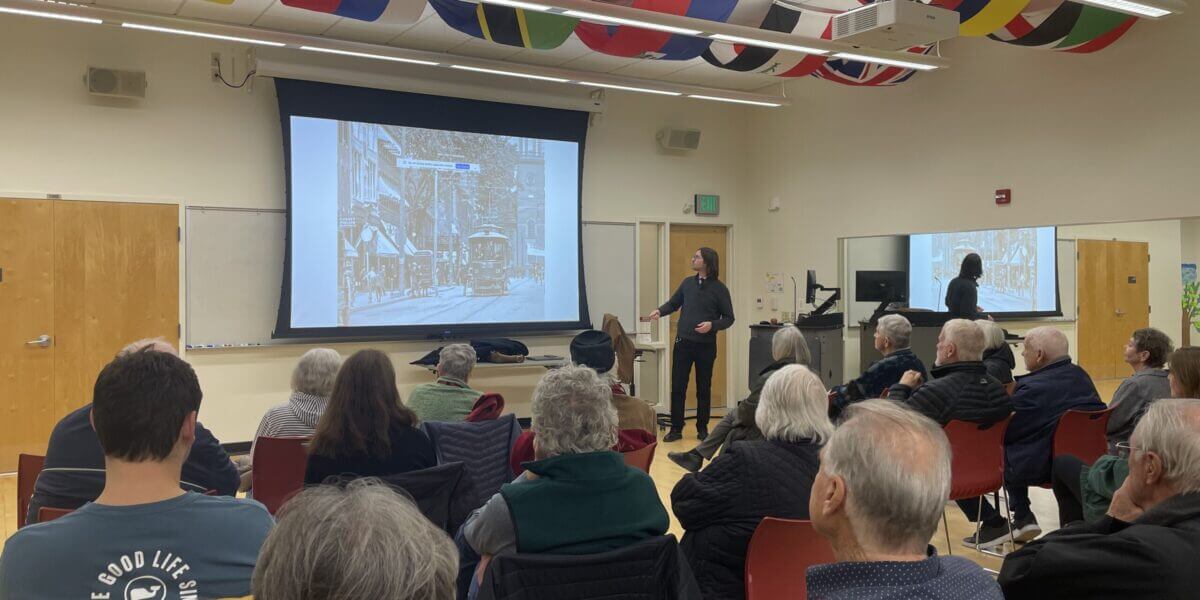
Father Michael Carter respectfully disagrees. “The records are there if you know where to look,” he told a small crowd last Thursday evening at CCV-Winooski. And that is just what the historian has spent countless hours doing: researching, imagining, and piecing together the stories of fellow Vermonters who served in the Great War. In the second iteration of his talk, “The Background, Lives, Service and Sacrifice of Burlington Vermonters During WWI” he set the stage for America’s involvement in the global conflict, and shared the stories of half a dozen Vermonters who served.
A grainy black and white photo shows the young face of Howard W. Plant, who lived at 20 Front Street. Born in 1899, he worked as a clerk at the department store Abernethy’s before joining the navy in 1916. He sailed on the USS Jacob Jones off the coast of England and France. His ship was torpedoed by a German submarine on December 7, 1917, and Plant lost his life along with 64 other men. He was the first person from Burlington to die in the war.
Jack J. London was born in 1896. His parents had emigrated to Burlington in the 1880s and Jack was one of six sons. He served as a radio operator on a freighter, and on October 4th 1918, his ship collided with a tanker 150 miles off the coast of Nova Scotia. Determined to continue communicating with nearby vessels, he valiantly stayed at his post but ultimately went down with the ship. He was the only Jewish person from Burlington to die in WWI.
Private Adelor Potvin was one of twenty Vermont men killed in action in a July 17, 1918 battle. He was also one of eight sons, three of whom fought in France at the same time. A worn newspaper clipping reports that “closely following the receipt of a telegram from Washington announcing that one son had been seriously wounded in France, Mrs. Selma Potvin of Archibald Street yesterday morning received a second official announcement that another son, Adelor, was killed in action…A third son remains unheard of from across the water.”
Interwoven with a sweeping history of fighting across Europe, Carter also shared the stories of Vermonters Arthur H. Finnerin, Richard Miller, and Edward Riley, along with photos from his own pilgrimage to France, where he visited monuments and cemeteries where U.S. soldiers are laid to rest.
Erik Zetterstrom serves as CCV’s veterans support coordinator, and he organized the Thursday lecture. The College serves roughly 400 veterans and military-connected students each semester, and as a support coordinator for this population, Zetterstrom’s work is focused on helping students succeed. From navigating VA benefits to accessing special scholarships and resources, he’s here to help smooth the transition between military and college life.
He was quick to point out that he doesn’t do this alone. “As a College, we have done a lot of work to bring [academic and financial aid] advisors, student accounts, and other staff sections together to share troubles and successes that we see our veteran and military-connected student community facing.” The College also recently hired Air Force veteran and CCV student Stephanie Hutches to serve as a student peer mentor. Through this coordinated network, CCV can offer stronger support. “CCV serves the veteran and military-connected student community as a team,” he said.
For Zetterstrom, a veteran himself, Michael Carter’s lecture embodies the College’s mission to support and honor the veteran community. “Because the percentage of Americans that have served our country is so small, I believe it is important to host events like this so that ordinary Americans can understand the service, sacrifice and love for our country that veterans have,” he said.
Learn more about Veterans Services at CCV.