“I was so happy that whole day.”
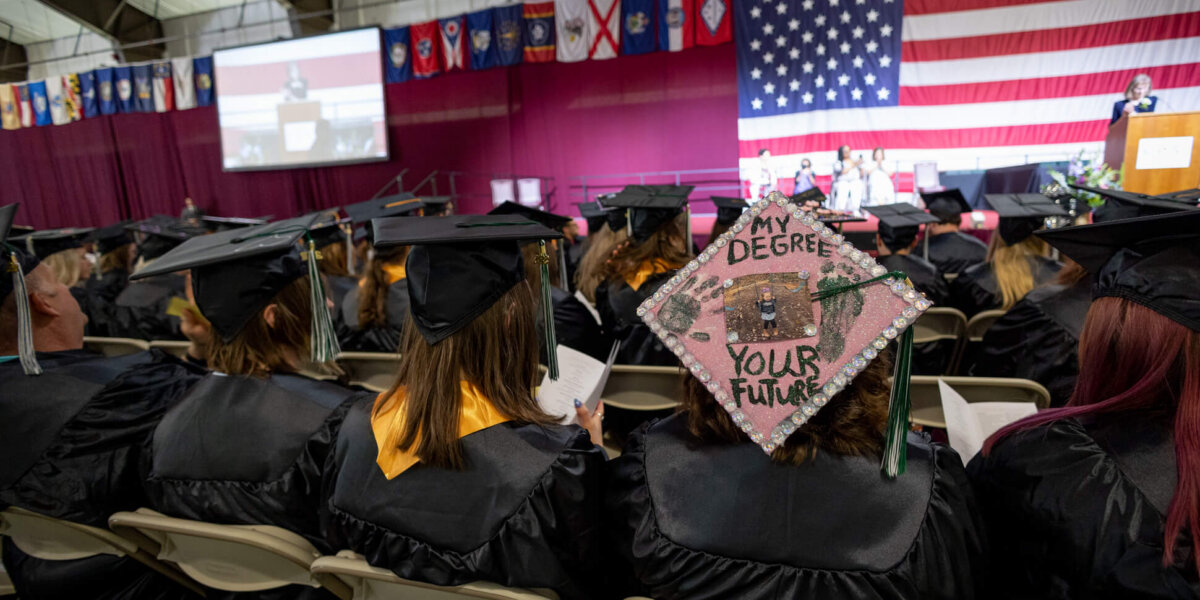
When Brie Ferguson walked across the stage at CCV’s commencement ceremony in June, “there was a lot of crying. But so happy, just so so happy.”
Graduation is emotional for most students, but it was particularly so for Ferguson, who’d begun her CCV career in prison. Ferguson spent more than two years in a Vermont correctional facility—what she described as a horrible experience—but a bright spot was being a CCV student. She took classes through the Corrections Post-secondary Education Initiative, a partnership between CCV and the Vermont Department of Corrections that provides free CCV classes to incarcerated Vermonters and DOC staff.
CCV’s commitment to access for all Vermonters led to the first iteration of its corrections education program in 2017. With support from the J. Warren & Lois McClure Foundation, ReSET VT delivered college classes to incarcerated students at Northern State Correctional Facility. In 2022, $4.5 million in federal funding secured by Senator Bernie Sanders helped CCV launch the Corrections Post-secondary Education Initiative, providing free classes for incarcerated Vermonters as well as DOC staff and family members. This spring, CCV received a $2.9 million grant from Ascendium Education Group, a national philanthropic organization, to expand its corrections work. The Corrections Education, Development, and Re-entry (CEDAR) center will focus on re-entry, academic persistence, and job placement.
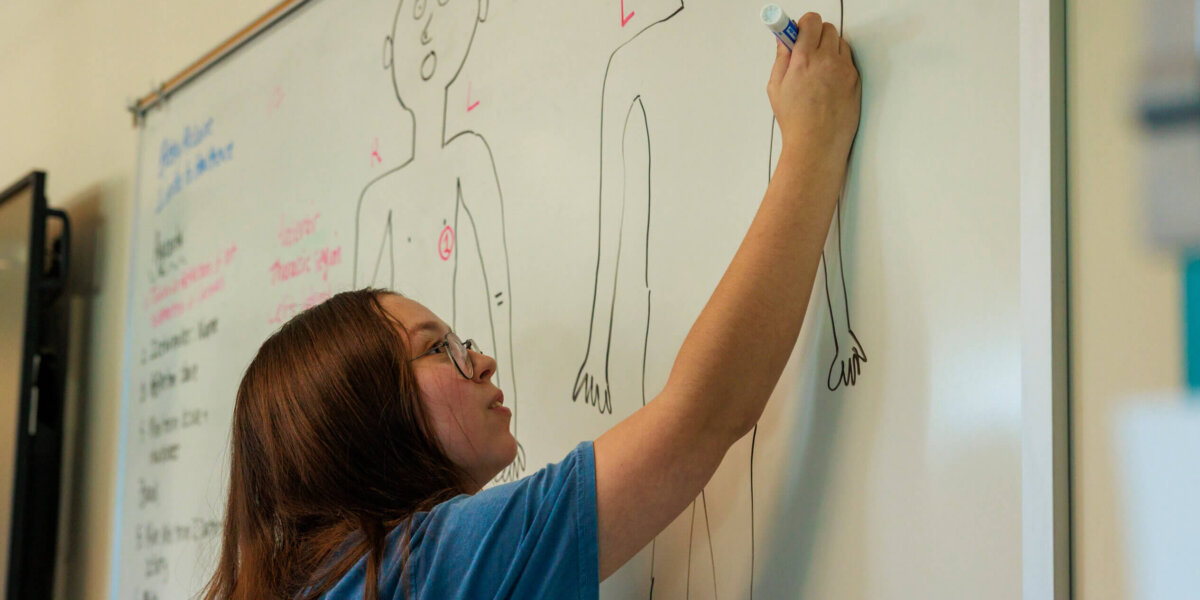
Brie Ferguson initially signed up for classes because “I just needed something to help me pass the time.” And it was exciting, she recalls, because it felt normal. “It’s not a normal setting at all, by any means,” but “what happened every week when faculty would come in was in your mind, your perspective changed of your setting. You weren’t in jail, you were in a classroom. That was so pushed on us: you’re students, you’re not inmates. You’re students in here and that’s all you are, and we’re gonna treat you like that, and you’re gonna be held to that standard. It gave a sense of normalcy that you’re looking for so hard when you’re there.”
It began as a means of passing the time, but then the possibility of earning a degree came into focus. “When I found out I didn’t have too long to go, that’s what my life became there. It was all school, all the time. I didn’t have time anymore to worry about anything else around me because I wanted to graduate so bad before I walked out of there that I could not be distracted by anything else.”
“I would cry by myself because I was so excited. I would be so excited to get out and know that I had this degree. I was so proud of myself that I couldn’t believe it. I knew that things were gonna be harder for me than the normal person and having that degree was gonna make it a little bit easier. And it has.”
Ferguson completed her liberal studies degree last December, and was then offered a six-month position on the Corrections Education team at CCV. Today, she’s returned to her home state and is continuing her education with the plan to eventually provide re-entry support for incarcerated women.
“It’s truly been the greatest accomplishment of my life, getting my associate degree,” Ferguson said. “I didn’t realize that once you get a little bit, you want more. So now I’m going for my bachelor’s. If I didn’t get the opportunity to get my associate degree through CCV I wouldn’t be here. I don’t know what I would be doing.”
Bryan Stanley-O’Connor is director of corrections education at CCV. One of the primary goals of the program, he says, is “improving the well-being of Vermonters. We feel a sense of responsibility to create access to something that’s not typically accessible for a group of people, and then look for opportunities to make meaningful, durable improvements on peoples’ lives.”
It’s not just the students who benefit, O’Connor says, but the whole ecosystem, from “residents who see students reading and working and think, ‘How can I go to CCV?’ to correctional officers who find greater job satisfaction in a more stable environment and may stay in their roles longer. These classes have an outsized impact because they change the culture inside the facilities.”
About 15% of Vermont’s sentenced population enrolls in a CCV course in any given semester. In 2025, more than 175 incarcerated students participated in corrections education—and the program celebrated its first graduate, Brie Ferguson.
“When you have an education, and when you start learning, it changes your personality a little bit too,” says Ferguson. “I’ve become more ambitious, more serious. It makes you grow up a little bit. Education, especially for formerly incarcerated people, is so important because they have so many barriers in front of them anyway, and when they have the education and the experience it really helps open doors. It really does…the more graduates come out of this program, it’s better for Vermont, it’s better for everything. It’s better for them personally, it’s better for the state. I just can’t stress enough how much more you need, being a formerly incarcerated person, to prove yourself and to show that you’re not bad, but an education is kind of the only way. It’s the means of moving forward.”
Note: Some names in this story have been changed to protect privacy.